
Get Support
+8801977426642
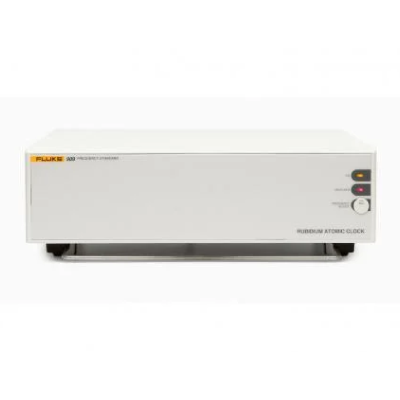
Fluke 908/909 Frequency References
The Fluke 908 and 909 Frequency Reference Standards are designed for use as accurate reference clocks in automated test systems and as in-house frequency standards. Because they require only a short warm-up time to reach specified stability, they can also be used as portable frequency standards. Now you can rent Fluke 908 & 909 Frequency References in Bangladesh – precision frequency standards for calibration and testing labs. Ensure accurate, reliable performance with certified rental solutions.
The 909 Frequency Reference includes an ultra-stable Rubidium timebase ("atomic clock"), while the 908 Frequency Reference is built around a high-stability oven-controlled cut crystal oscillator. Both instruments provide five buffered 10 MHz outputs plus one 5 MHz output. Option 70 increases the number of 10 MHz outputs to ten.
Ideal for automated test (ATE) systems
Many production test systems, particularly in the telecommunications industry, require a stable external frequency clock as a reference. Depending on your needs, either the 908 or the 909 can supply a stable frequency reference to up to 11 other instruments and testers, making them ideal for use in an ATE system. In addition, there is a rack mounting kit available.
908 (Crystal oven)
With its high-stability oven-controlled SC-cut crystal oscillator, the 908 offers the lowest purchase cost per output on the market in the 11-output version (option 70 installed).
909 (Rubidium)
The Rubidium version, with its negligible aging drift, needs in practice no adjustment during the lifetime of the test system.
In-house frequency standards
Both the 908 and the 909 Frequency References are ideal for use in calibration laboratories where there is a need to calibrate a wide range of instruments, such as frequency counters and synthesizers. Unlike off-air frequency receivers, the 908 and 909 have very high short-term stability that enables much faster frequency calibration.
Companies that require frequency standards in numerous departments spread over several buildings will find that a local Rubidium standard (909) normally offers a more cost-effective solution than a central reference with a costly distribution system.
Made for portability
The 908 and 909 Frequency References are designed for portability. They perform exceptionally well as transportable fast-warm-up frequency references. Traditionally, oven oscillators using AT-cut crystal could not maintain their specification without continuous battery backup during transportation to different sites. This is because AT-cut crystals suffer from significant frequency retrace (frequency offset after a power interruption). They also need a very long warm-up time, 24 hours or more, to arrive at the final frequency value.
The 908's oven oscillator is designed around the more advanced SC-cut crystal oscillator, which has virtually no retrace. In just 10 minutes, the frequency is within 5x10⁻⁹ of the final value, meaning it can be in service faster. Finally, there is no need for battery backup during transportation. The warm-up of the Model Rubidium oscillator is even faster, taking only 10 minutes to reach as close as 4x10⁻¹⁰ from the final frequency.
For protection during transport and storage, there is a carrying case available. The 908 and 909 provide stable, cost-effective solutions for your frequency reference requirements, whether in ATE, laboratory, or portable applications.
Key Features: Fluke 908/909 Frequency References
- Designed for calibration laboratories, ideal for calibrating a wide range of instruments, offering excellent short-term stability for faster frequency calibration.
- Serve as an accurate "Atomic clock" reference in automated test systems.
- Fast warm-up time, increasing productivity and efficiency in calibration tasks.
- Cost-effective solution for frequency standards located in multiple departments or buildings, eliminating the need for a costly central reference distribution system.
Specifications: 908/909 Frequency References
| Reference outputs | ||
| Base model | 5x10 MHz, 1x5 MHz: sine >0.6V rms in 50Ω | |
| With Option 70 | 10 x 10 MHz, 1 x 5 MHz: sine >0.6V rms in 50Ω | |
| Frequency Stability | ||
| Aging per month | 908 (Oven) | 3x10⁻⁹ |
| 909 (Rubidium) | 5x10-11 | |
| Aging per year (per 10 years) | 908 (Oven): | 2x10⁻⁸ (1 year) |
| 909 (Rubidium) | 1x10⁻⁹ (10 years) | |
| Temperature | (20°C to 26°C) | |
| 908 (Oven): | 4x10⁻¹⁰ typ | |
| 909 (Rubidium): | 2x10-11 typ. | |
| -------- | ||
| 0°C to +50°C) | ||
| 908 (Oven): | 2.5x10⁻⁹ | |
| 909 (Rubidium): | 3x10⁻¹⁰ | |
| Short term (root Allan variance) | 908 (Oven): | 5x10-12, t= 10s |
| 909 (Rubidium) | 1x10-11, t=10s | |
| -------- | ||
| 908 (Oven): | 5x10-12, t=1s | |
| 909 (Rubidium) | 3x10-11, t=1s | |
| Warm up (at +25oC) | 908 (Oven): | 10 mins. to 5x10⁻⁹ |
| 909 (Rubidium) | 5.4 mins. to lock | |
| 11 mins. to 4x10⁻¹⁰ | ||
| Environment | ||
| Temperature | 0°C to +50°C (operating) | |
| -40°C to +70°C (storage) | ||
| Safety | Compliant to EN 61010-1 and CE | |
| EMI | Compliant to EN 55011 ISM group, class B, EN 50082-2 and CE | |
| Power Consumption (90-264V, 47-63 Hz) | ||
| 908: | <20W at warm up, < 7W continuous operation | |
| 909: | <70W at warm up, <30W continuous operation | |
| Dimensions and Weight | ||
| Size | 315 x 86 x 395 mm | |
| (12.4 x 3.4 x 15.5 ins) | ||
| Weight | 4.8 kg (net), 7.8 kg (shipping) | |
| (10.6 lb (net), 18.2 lb (shipping) | ||
| Calibration | ||
| Calibration Documentation | 17025 accredited report of calibration included | |


